

A family dinner in Changsha turned into a lesson in performance, design, hierarchy, and the quiet choreography built into the objects around us.
By Jason Woodworth-Hou, PhD, MFA
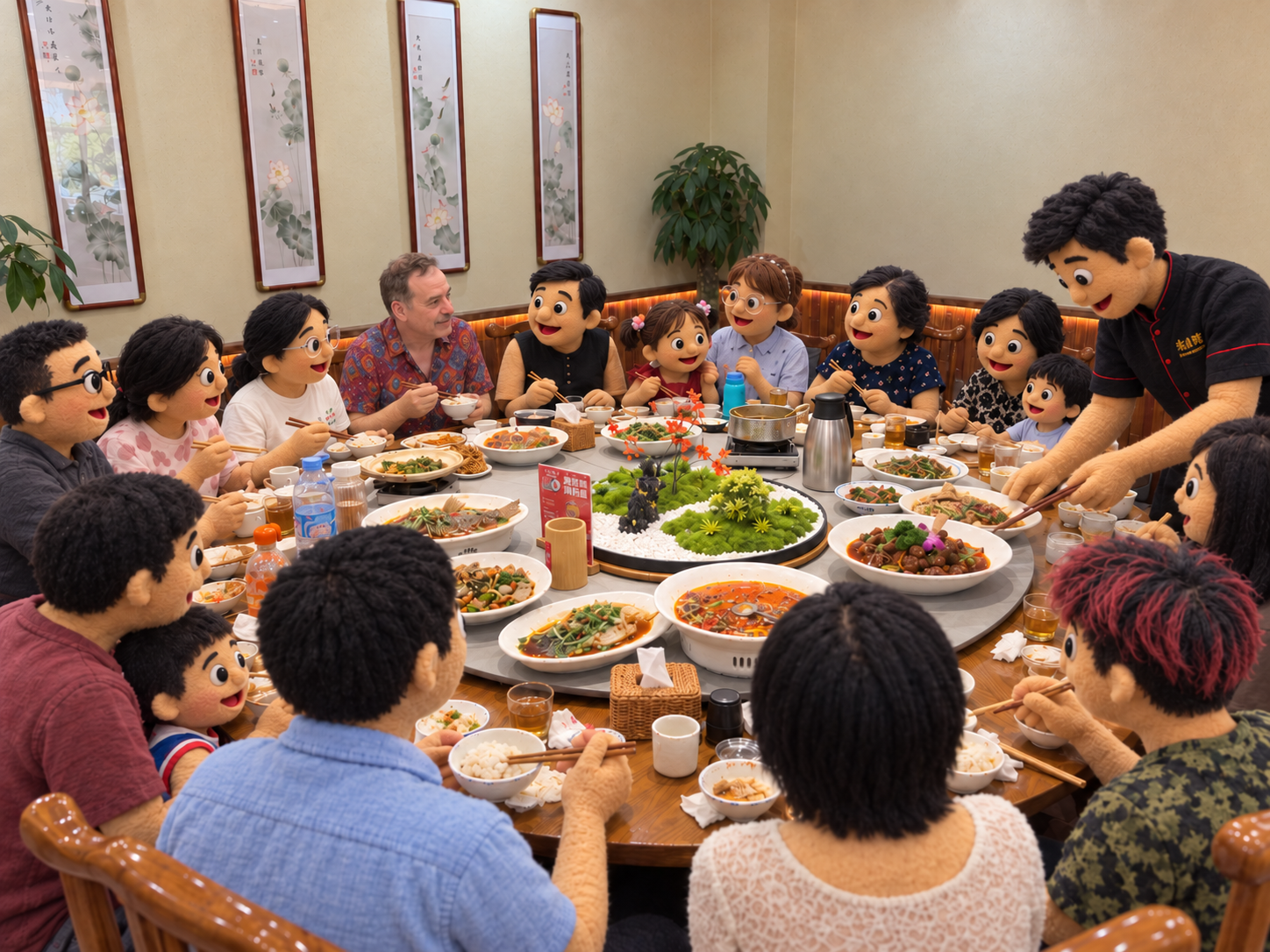
A family dinner in Changsha. The circular table and rotating center are not merely scenery in this essay; they become part of the social action. Author-supplied production image.
“I had walked into the room thinking I was attending a dinner. In retrospect, I was watching a small cultural rehearsal.” |
THE ROOM
My wife and I never had a formal wedding reception in China. We did have a small, impromptu reception with fewer than twenty guests in an upstairs banquet room in Michigan. Four rectangular tables were pushed together to make one long central table where we sat with our son, with two more tables flanking us to create one large rectangular space. Fourteen years later, we arrived in Changsha, my wife’s hometown, for dinner with many of her Chinese family members. I imagined that perhaps this was finally our “Chinese reception,” though this was not formally stated. There were roughly as many people as there had been all those years ago.
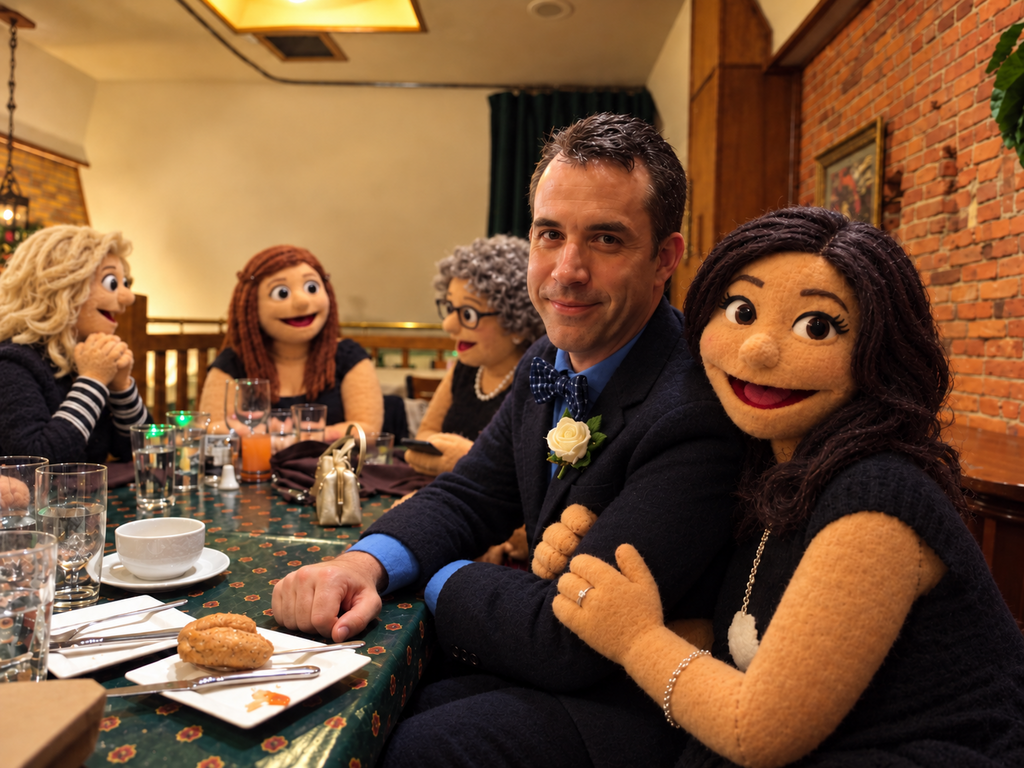
Michigan reception, 2013: the meal organized around a rectangular arrangement. Author-supplied production image.
“I had no idea that
where I sat mattered.”
The geometry looked equal.
The etiquette was not.
But the room looked completely different. Instead of a collection of rectangular tables, one massive circular table occupied most of the room. From somewhere near its center came a persistent buzzing noise. I eventually realized the sound was coming from the motor beneath a huge turntable rotating clockwise, almost imperceptibly slow, in the middle of the table.
“Where do we sit?” I spoke into the translator and played it for the waiter. He looked at my large, white frame. “You sit here.” He pointed to the chair furthest from the entrance. I sat down, drank some tea, and rinsed the dishes in hot water, something I needed to be instructed on by my mother-in-law as she entered the room.
Then people began arriving. My uncle-in-law invited me to move closer to him near the entrance. That sounded good to me. So my wife, son, and I moved across the table. My mother-in-law took the chair I had just vacated. At the time, none of this meant anything to me. I had no idea that where I sat mattered.
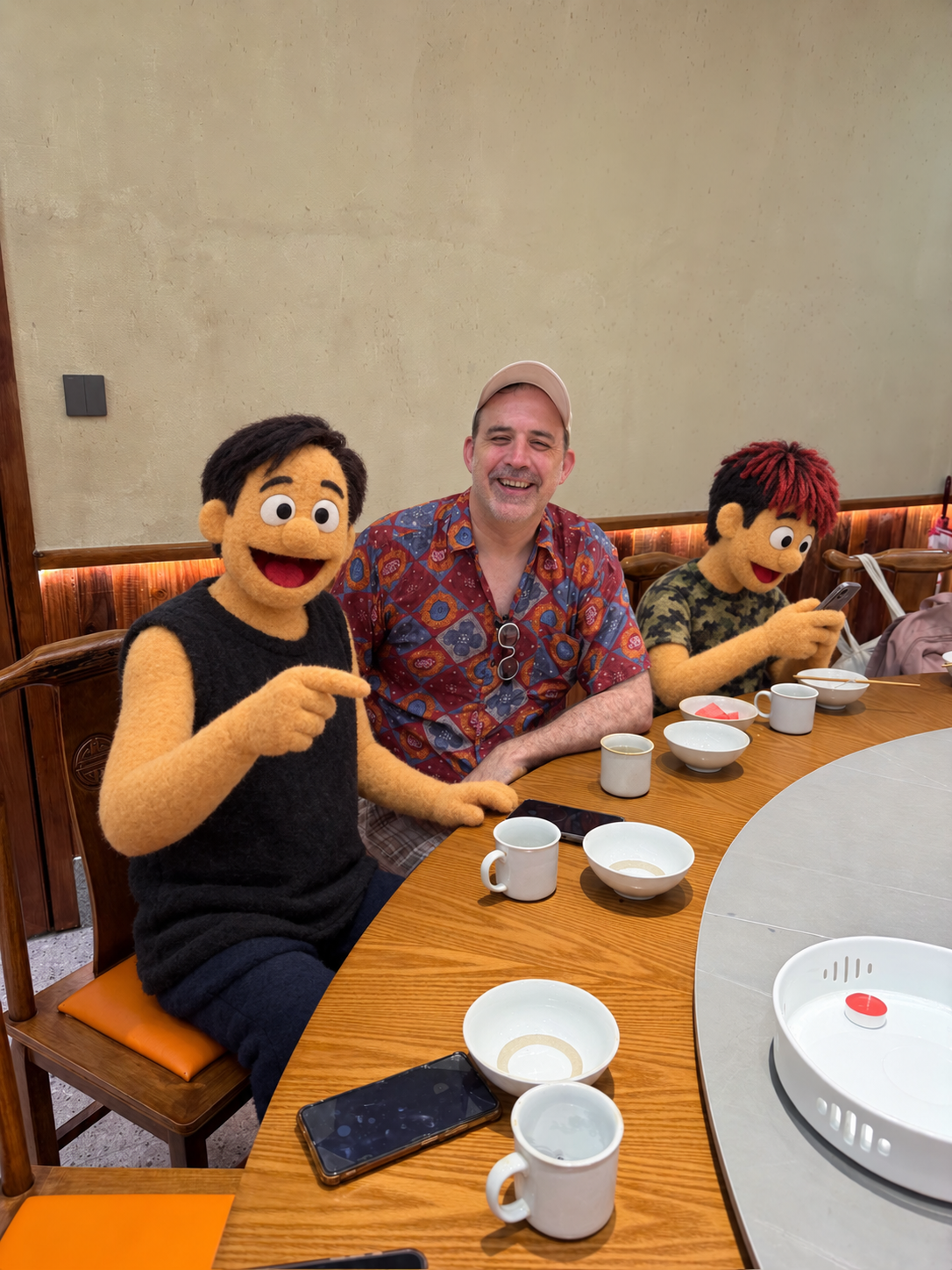
At the table in Changsha. The essay’s later question—who belongs where?—was already being answered through movement before I understood the rules. Author-supplied production image.
At the table in Changsha. The essay’s later question—who belongs where?—was already being answered through movement before I understood the rules. Author-supplied production image.
As the food arrived, a waiter came repeatedly over my right shoulder carrying dishes that would feed the entire table. He had also turned up the speed on the turntable motor so that he could quickly place the communal dishes. The waiter placed one dish onto the turntable and then another. The table carried each away, clearing room for the next. My new seat gave me the closest view—and smell—of almost everything before it entered circulation. One uncle produced a bottle of liquor he was especially proud of and began offering it around the table. Several of the women laughed and waved both hands in a very clear no-for-me gesture. Whether it was the efficiency of the serving or the alcohol that made the evening move so quickly, I cannot say. But it was everything I had imagined a Chinese family reception might be: laughing, talking, and eating. A lot of eating. Food, unlike our reception in Michigan, felt like the unstated guest of prominence.
THE TABLE AS SET
And somewhere during the meal, the director in me started paying attention to the set.
“A large round table. People distributed evenly around its edge. A rotating platform filling the center. Shared dishes constantly entering and leaving everyone’s reach.” |
I was trained to think about rooms this way. Anne Bogart and Tina Landau’s Viewpoints gave directors of my generation a vocabulary for examining things we often understand instinctively: architecture, spatial relationship, gesture, tempo, duration. Change the distance between two actors and you change the scene. Put a wall between them, and you change it again. Move a chair three feet and suddenly someone may appear isolated, dominant, trapped, or exposed. Architecture does not determine human behavior, but it gives behavior somewhere to happen.1
Don Norman approaches the same idea from another direction in The Design of Everyday Things. Everyday objects quietly suggest how they should be used. A door handle invites a pull. A flat plate invites something to be placed on it. A control that moves in a particular direction teaches us what to expect when we touch it. The object does not force the behavior. Its design simply makes certain actions easier, more obvious, or more awkward than others.2
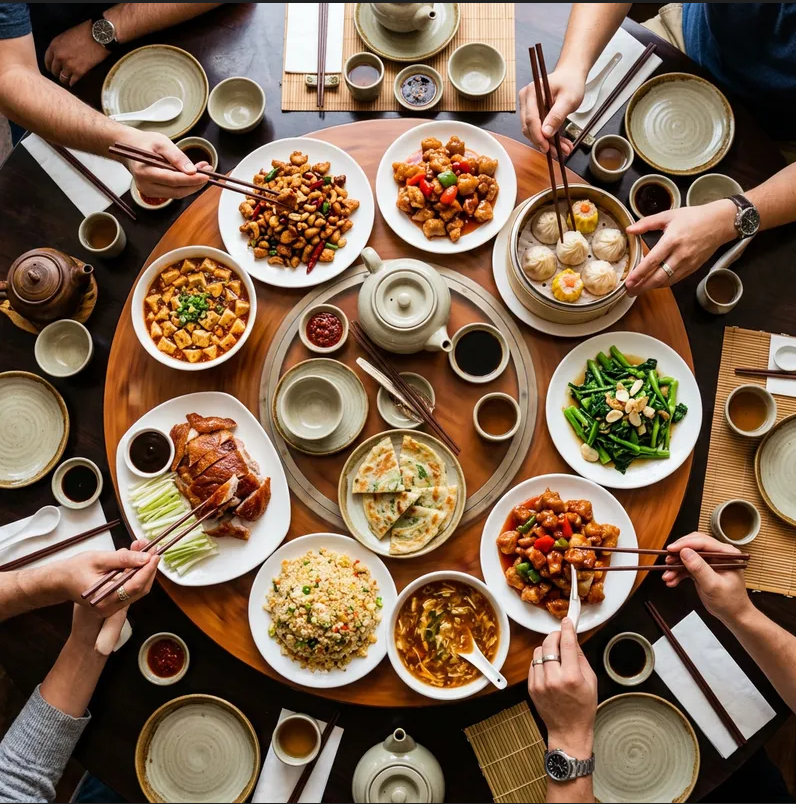
An overhead view makes the behavioral geometry visible: center, reach, circulation, and shared access. Author-supplied production image.
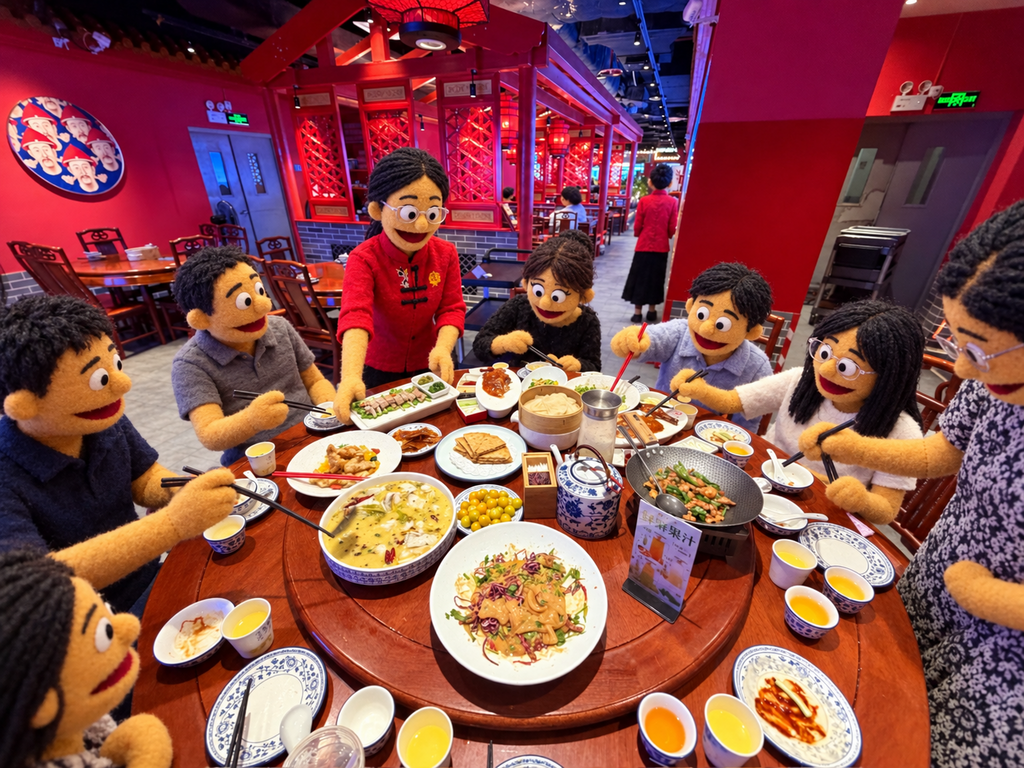
A communal meal in a Chinese restaurant: the table organizes a shared field of attention rather than a set of isolated plates. Author-supplied production image.
That makes immediate sense to me as a director. Put a sofa in the middle of a room and people gather around it. Put a long table between two characters and distance, status, and negotiation enter the scene before either actor says a word. Looking at the Lazy Susan this way, I began to wonder whether it was doing much more than helping us reach the food. It was quietly organizing the behavior of everyone around it. Every new dish changed the room. The waiter placed something on the rotating center and it began making its circuit. Someone noticed it approaching. Someone else waited. A person served themselves and let it continue. Another dish returned nearly empty while something less popular survived several rotations almost untouched. You could watch preferences emerge without asking anyone. There was a dialogue taking place between the food and its eaters.
During our meal in Changsha, conversation almost disappeared once enough dishes began circulating. For a few minutes, there were mostly the sounds of eating—chewing, slurping, bowls and chopsticks. People looked across the table at one another with full mouths. Then, as everyone slowed down, conversation returned. “Have you tried this?” “That was decent, but I’ve had better.” “I’ve never had that before.” And the object under discussion might conveniently rotate past us again thirty seconds later. The table had introduced a kind of rhythm into the meal.
HIERARCHY INSIDE THE CIRCLE
Only afterward did I learn that another performance had been taking place around me. There is traditionally a seating hierarchy at formal Chinese banquets. At a round table, the position facing the entrance is commonly treated as the seat of honor, reserved for the host, an elder, or an especially important guest depending on the occasion. People of greater status are generally seated closer to that position. Thinking back, I realized that this was the seat where I had originally been placed. And then my mother-in-law had taken it. I am not convinced I was ever truly supposed to be the guest of honor. The waiter may simply have looked at the very large white American entering the room and made an assumption. My mother-in-law occupied that chair effortlessly. She was the matriarch of this family and had the personality to go with it. Later, when I asked everyone to gather for a photograph, they clustered around her seat. That was when I finally understood where the center of this particular room had been all along.3
What interested me was how poorly the table itself had communicated that hierarchy to me. A circle has no obvious head. Walk into a room containing a long rectangular table and you can immediately see its ends. Distance stretches away from them. One person can occupy a visually dominant position while someone else sits twenty feet away. A circle disguises that geometry. Everyone appears to have roughly equal access to the center. Yet hierarchy had not disappeared from our table in Changsha. It had simply moved somewhere else. Into etiquette. Into expectation. Into knowing where to sit.
RACK FOCUS: AMERICA
That realization made me think about the dining rooms I know in the United States. Most restaurant meals I encounter there begin with individual plates. My food arrives in front of me. Yours arrives in front of you. The shared table is still there, but the meal has already been partitioned. Americans certainly know communal dining. Thanksgiving may be one of our clearest examples, when suddenly the table fills with bowls and platters and the familiar refrain begins: “Can you pass the potatoes?” “Could I get the rolls?” “Who has the gravy?” From a director’s position, those little negotiations are fascinating.
If two characters are angry with each other, simply placing the mashed potatoes beside one of them can create a problem. How badly does the other person want them? Will they ask? Will someone intervene? Will they reach across the table? A character figuring out how to get a desired dish can, in the right scene, become rehearsal for how that character will try to get something much more important later.
THE TABLE ONSTAGE
Dinner scenes can be surprisingly difficult to stage for exactly this reason. A director has to think about what the audience already understands about the space, but also about the practical problem of letting the audience see what is happening. A realistic dining room works differently in life than it does on a proscenium stage. Put actors naturally around all four sides of a table and half of them may spend the scene with their backs to the audience.
I once saw a production of Tennessee Williams’s The Glass Menagerie where the table itself accidentally became part of the performance. During the dinner scene, Amanda Wingfield is desperately engineering a pleasant interaction between her daughter Laura and the “gentleman caller” Tom has brought home from work. Tom finally explodes. The actor slammed his fist onto the table. Unfortunately—or wonderfully—a pickle happened to be resting on the handle of a fork. The fork became a catapult. The pickle shot upward and landed in the hanging light fixture above the table. No director planned this. The actor playing Tom did not break character. Still furious, he circled the table, made the gentleman caller get out of his chair, climbed onto it, retrieved the pickle from the light, slammed it back onto the table, returned to his own chair, turned away from everyone else, and sat there in silence. It was perfect. The actor took an accident created by the architecture and the props and turned it into behavior that felt completely truthful to the scene.
“That is what spaces and objects do in performance. They create possibilities. People decide what to do with them.” |
THE ROUND TABLE
Which may also explain why the Round Table became such a durable symbol in Western culture, despite its lack of popularity in most actual dinner spaces. Medieval storytellers imagined King Arthur’s circular table as a place where his knights could sit without one occupying the privileged head. Even inside a deeply hierarchical medieval world, the circle offered an architectural image of equality. That does not mean the knights were actually equal. It means people understood what the shape suggested. Centuries later, sitting around another round table on the other side of the world, I found myself confronting the same contradiction. The table suggested equality. The social choreography did not necessarily erase hierarchy. It reorganized it.4

King Arthur’s knights gathered at the Round Table and seeing a vision of the Holy Grail, c. 1470. Évrard d’Espinques, Bibliothèque nationale de France, MS Français 112; image via Wikimedia Commons, Public Domain Mark 1.0.
THE REHEARSAL
And now, knowing what I know about that dinner in Changsha, I keep replaying the moment when the waiter pointed me toward that chair of honor. I still do not think I would have reclaimed it. My mother-in-law had organized the dinner. She was the matriarch of the family. Whatever conclusion the waiter had reached when he saw me enter the room, I suspect my uncle understood the scene more clearly than I did when he asked me to come sit with him. Perhaps he simply wanted to speak with me. Or perhaps moving me was a smooth little act of social direction—a face-saving correction performed so naturally that I did not recognize it as one until much later. Either way, I had walked into the room believing I was choosing where to sit. Everyone else may already have known the blocking.
Looking back, I think that is what the Lazy Susan was doing all along. It was not simply moving food around the table. It was giving everyone a set of repeated actions: wait, reach, serve, notice, yield, take, watch what others choose, understand where you sit in relation to everyone else. None of those actions alone explains a culture, but repeated often enough, they become part of how culture is practiced. A director might call it blocking. Don Norman might call it design shaping behavior. I had walked into the room thinking I was attending a dinner. In retrospect, I was watching a small cultural rehearsal, and the machine in the middle of the table was helping conduct it.
DISCUSSION What object or room in your everyday life quietly organizes how people behave around it? |
NOTES & SOURCES
1. Anne Bogart and Tina Landau, The Viewpoints Book: A Practical Guide to Viewpoints and Composition (New York: Theatre Communications Group, 2005). The essay uses their vocabulary of architecture, spatial relationship, gesture, tempo, and duration as a directing framework.
2. Donald A. Norman, The Design of Everyday Things, rev. and expanded ed. (New York: Basic Books, 2013); Donald A. Norman, “Signifiers, Not Affordances,” Interactions 15, no. 6 (2008): 18–19, https://doi.org/10.1145/1409040.1409044. Norman distinguishes affordances—the actions possible—from signifiers, the perceptible cues by which people discover possibilities for action.
3. Wei Yen, “Etiquette with Chinese Characteristics,” in From the Great Wall to Wall Street: A Cross-Cultural Look at Leadership and Management in China and the US (Cham: Springer, 2017), 165–78, https://doi.org/10.1007/978-3-319-33008-2_9. Contemporary research on Chinese business banquets likewise describes round-table seating with the principal host facing the door and other participants placed according to status or seniority: see “Till We Have Red Faces: Drinking to Signal Trustworthiness in Contemporary China,” Public Choice (2024), https://doi.org/10.1007/s11127-024-01180-2.
4. Wace introduced the Round Table in the Roman de Brut (1155). The British Library describes Wace’s Arthur as gathering leaders around the table as part of an image of fair rule and international statesmanship: “King Arthur: fable, fact and fiction,” British Library, accessed October 2, 2026. The manuscript illumination reproduced here is Évrard d’Espinques, c. 1470, BnF MS Français 112, via Wikimedia Commons, Public Domain Mark 1.0.
BIBLIOGRAPHY
Bogart, Anne, and Tina Landau. The Viewpoints Book: A Practical Guide to Viewpoints and Composition. New York: Theatre Communications Group, 2005.
Norman, Donald A. The Design of Everyday Things. Revised and expanded edition. New York: Basic Books, 2013.
Norman, Donald A. “Signifiers, Not Affordances.” Interactions 15, no. 6 (November–December 2008): 18–19. https://doi.org/10.1145/1409040.1409044.
Yen, Wei. “Etiquette with Chinese Characteristics.” In From the Great Wall to Wall Street: A Cross-Cultural Look at Leadership and Management in China and the US, 165–78. Cham: Springer, 2017. https://doi.org/10.1007/978-3-319-33008-2_9.
“Till We Have Red Faces: Drinking to Signal Trustworthiness in Contemporary China.” Public Choice. 2024. https://doi.org/10.1007/s11127-024-01180-2.
British Library. “King Arthur: fable, fact and fiction.” Accessed October 2, 2026.
IMAGE CREDITS
• Reception Family DInner.png — author-supplied production image.
• Wedding Reception in 2013.png — author-supplied production image.
• Me and Unc.png — author-supplied production image.
• Hong Kong Restaurant.png — author-supplied production image.
• Still Table.png — author-supplied production image.
• Évrard d’Espinques, King Arthur’s knights at the Round Table seeing a vision of the Holy Grail, c. 1470, Bibliothèque nationale de France, MS Français 112; via Wikimedia Commons, Public Domain Mark 1.0.
• China Made Me Rethink America series logo — author-supplied graphic.