
CHINA MADE ME RETHINK AMERICA
Shenzhen:
The World’s Biggest Toy Box
A trip through Shenzhen’s electronics markets made me wonder what America lost when tinkering moved from physical spaces to screens—and what I carried with me before I ever arrived in China.
Jason Woodworth-Hou
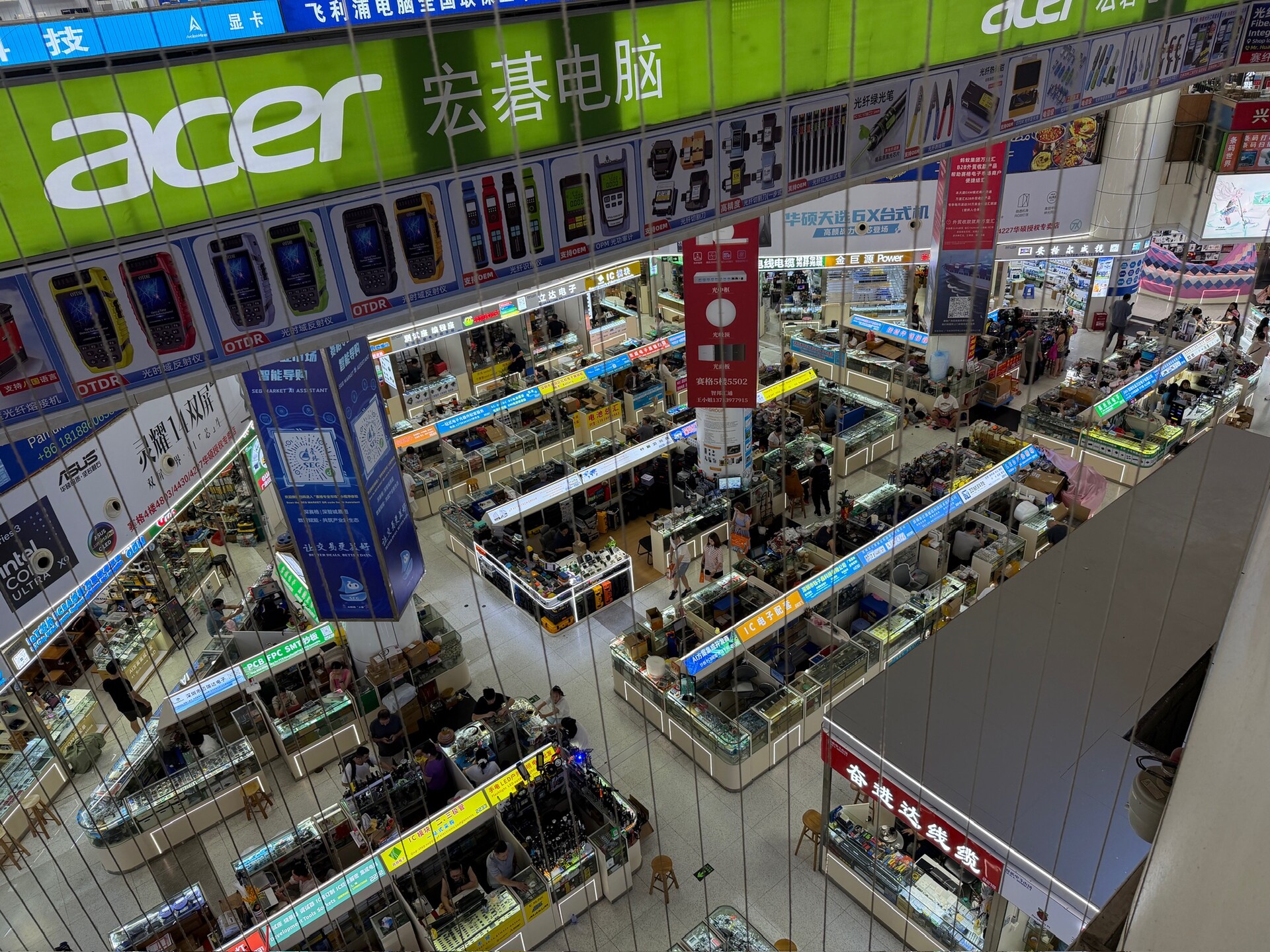
Inside Shenzhen’s electronics markets, components, tools, and possibilities seem to stack on top of one another.
“Do they work?”
My son and I were standing in Shenzhen’s Yuanwang Digital Mall looking at 3D-printed rocket launchers mounted beneath 3D-printed drones. The salesperson had appeared at my shoulder the moment I spent more than a second studying them.
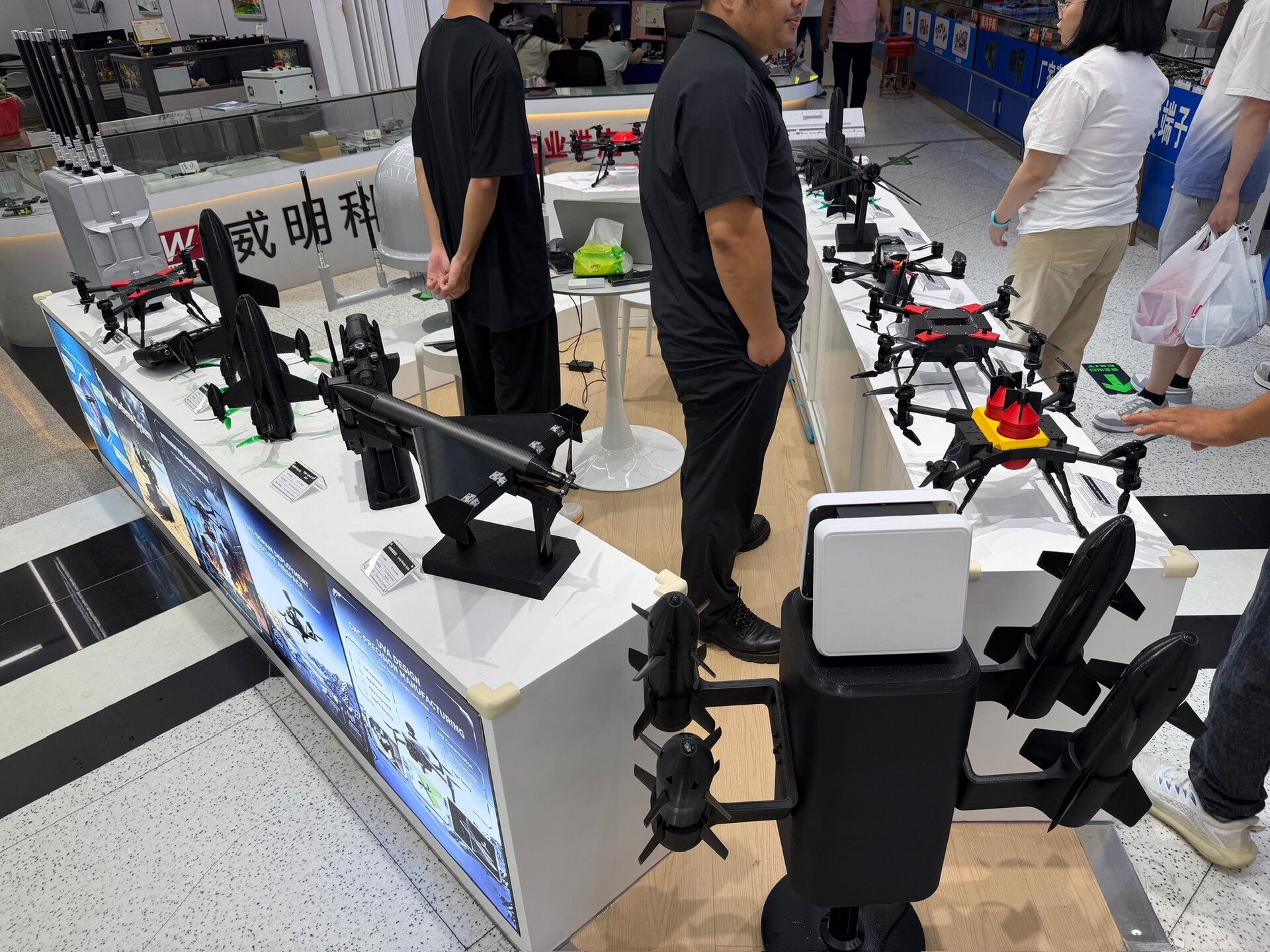
A drone display in Shenzhen that prompted my first question: “Do they work?”
“Yes. All 3D printed. Do you 3D print?”
“Yes, but I want to know: do they fire rockets from a drone? Do they work in real life?”
“OH! No, no, no, no. That is illegal and bad. They are for imagination.”
His answer stuck with me.
“What excited me about technology was not the technology itself. It was its ability to take something that existed in the imagination and make it physical.”
My son and me tinkering with motion-capture technology at the University of Georgia in Athens.Nearby was a massive computer housing liquid-cooled equipment built for AI, a digital guitar designed to teach beginners new songs, and some of the now-ubiquitous translation devices I saw throughout China. None of them was quite as miraculous as the display suggested. The giant computer wasn’t something I could test. The guitar did a pretty shoddy job of teaching guitar. Even the “AI” translators had trouble with more than a sentence at a time. But maybe polished functionality wasn’t entirely the point. Standing there, the message I kept receiving was: Look. I made this. Could you make it real? Could you make it better? That was the feeling I had been chasing since I entered the building.
My Chinese in-laws had told me that the Digital Mall was one of the first places I had to visit in Shenzhen. They knew that my love for LED technology, audio gadgets, computers and, of course, video games went well beyond my career interests. And once I stepped inside, I got an old feeling I hadn’t experienced in years—the feeling I used to get walking into RadioShack in the 1980s and later Circuit City, CompUSA or, the holy grail, Fry’s Electronics. Those stores made technology feel like possibility. Something on a shelf might make your life a little easier, a little lighter or simply more fun.
I grew up with a healthy admiration for the tinkerer. The Nutty Professor, Caractacus Potts, the Absent-Minded Professor, Q, Tony Stark—my childhood and adulthood were filled with characters who solved problems by making things. I may even owe my eventual dive into dramatic media to that fascination. At the University of Georgia, I learned what an Arduino was and how MIDI-based systems could trigger sequences that made a performance space appear alive before a human performer stepped onto it. What excited me about technology was not the technology itself. It was its ability to take something that existed in the imagination and make it physical. Eventually I was a theatre director who had become, at least occasionally, an engineer and programmer. So walking through the Digital Mall, the child and the tinkerer in me were having a party.
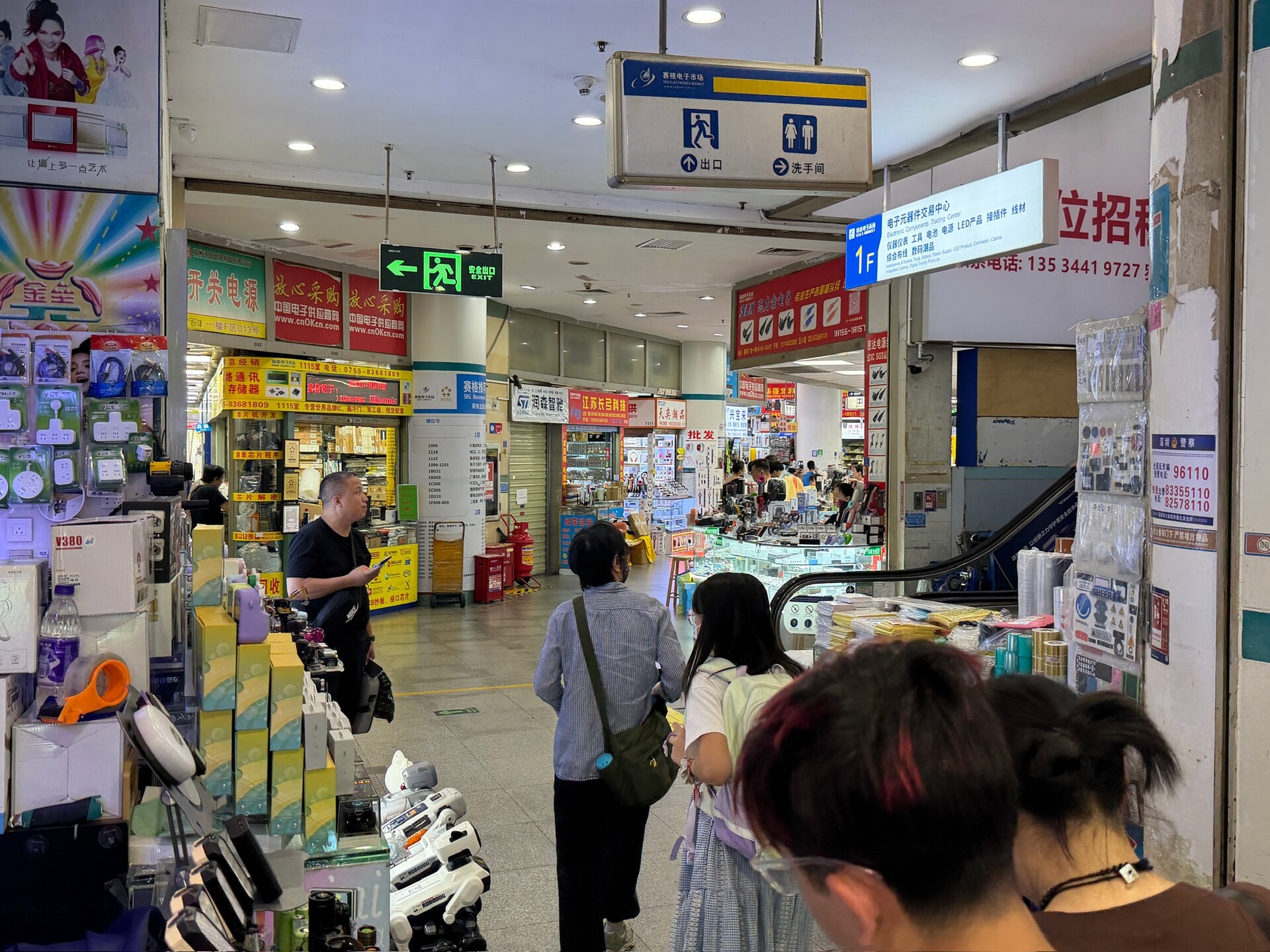
Floor after floor of small electronics stalls made the market feel less like a store than an ecosystem.
The building rose floor after floor in a dense, almost cyberpunk accumulation of technology. Small storefronts, many only ten or fifteen feet across, sat beside larger brand-name stores. Kiosks occupied nearly every remaining space. Personal fans. Massagers. USB chargers. In-ear translators. AR glasses capable of displaying translations. Then more fans, more chargers, more translators. At first, a lot of it seemed like the same stuff over and over.
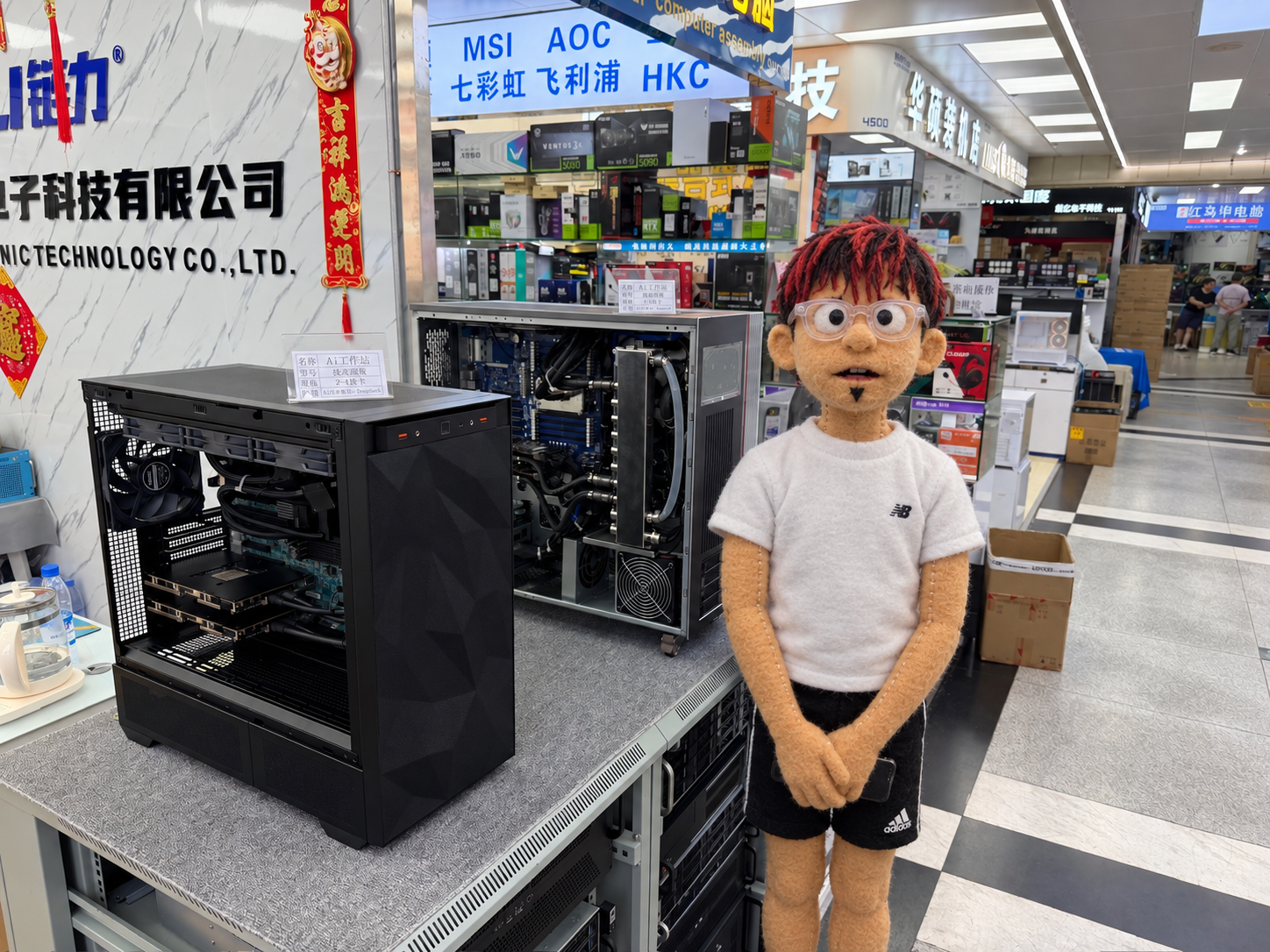
My "muppetized" son in Shenzhen, still hoping there might be a deal hiding somewhere among the computer hardware.
My son had a more specific mission. He was determined to find a deal on a GPU, CPU or RAM that he could flip in the United States. He quickly discovered that sellers in Shenzhen were perfectly aware of what the same equipment cost on Amazon and Newegg. New equipment wasn’t necessarily a bargain. So we kept climbing.
Higher in the mall, the displays became less polished. Stacked boxes formed narrow aisles. People disappeared between them carrying canvas bags and phones, digging through bins and checking prices as they went. These were the people who fascinated me.
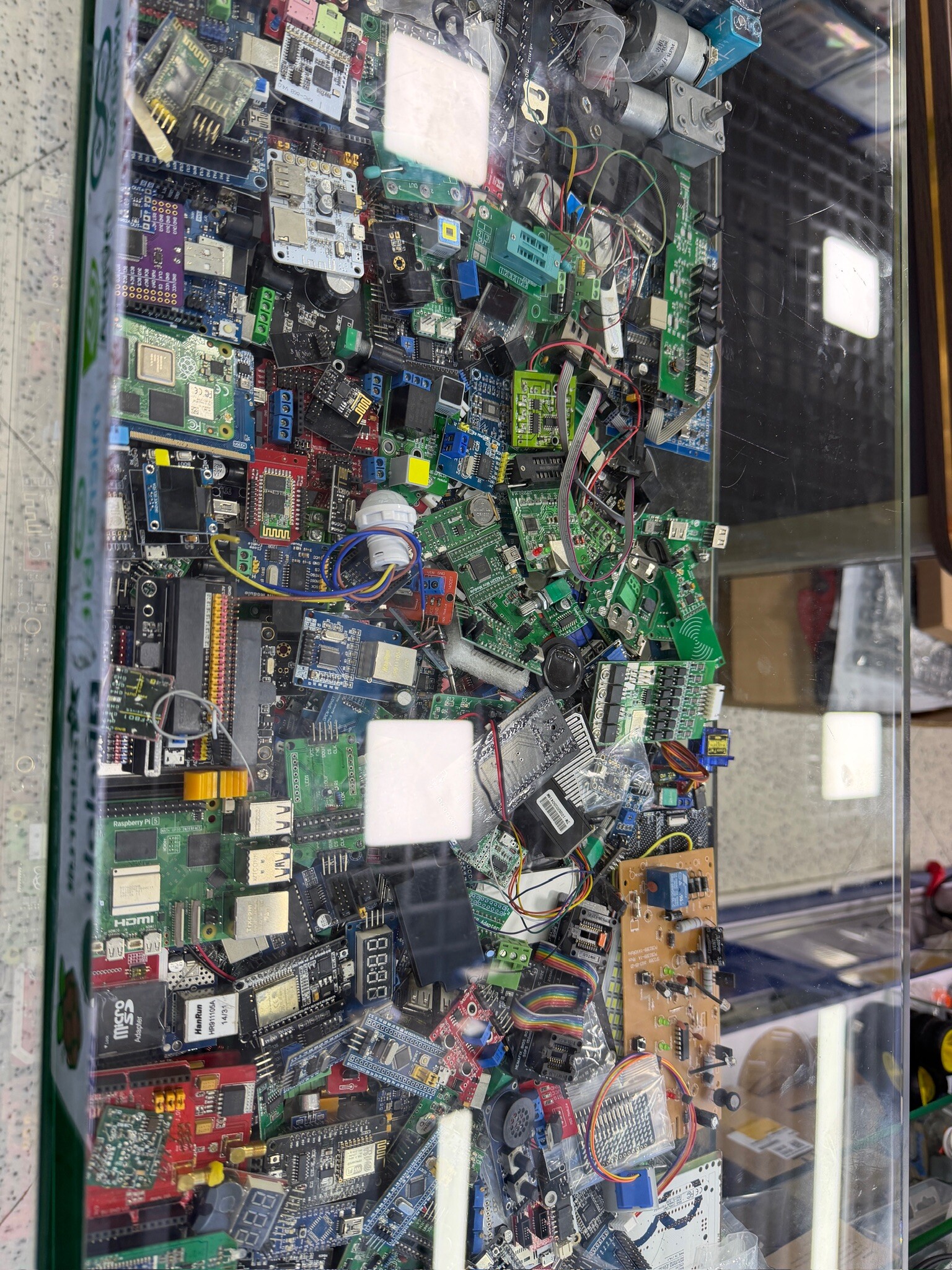
Boards, controllers, and components offered individually—the raw material of somebody else’s next idea.
WHAT THE MARKET KEPT SUGGESTING |
I had already read and watched stories about Shenzhen makers who could assemble a working cellphone from components found in markets like this. Whether or not everyone pawing through those bins was building the next great invention, the physical environment itself suggested something I had not felt in an American electronics store for a long time:
Make something.
The mall reminded me less of a modern electronics retailer than of the hardware stores, lumberyards, fabric stores and workshops where people once gathered around the physical materials of their crafts. Someone had made something. Someone else wanted to know how. Another person thought they could make it better. The technology had changed. The behavior felt ancient. And that made me rack focus back toward home.
America loves the mythology of the tinkerer. We celebrate startups born in garages, airplanes born in bicycle shops and computers assembled by people who were not supposed to know yet that they were changing the world. But where are the physical spaces where today’s tinkerers gather? Where do they drink coffee and argue about what they built in the lab? Where does someone stumble across the odd component that solves a problem they weren’t even trying to solve that morning? Where are the bins of possibilities?
Maybe they don’t need them anymore. Most of those conversations have moved online. Maybe I am simply mourning RadioShack and Fry’s Electronics because they belonged to my youth. Maybe Discord, Reddit, YouTube, GitHub and online marketplaces do everything those physical places once did, only better. But standing in Shenzhen made me wonder what gets lost when the conversation between people, objects and ideas no longer happens in the same physical space.
RACK FOCUS
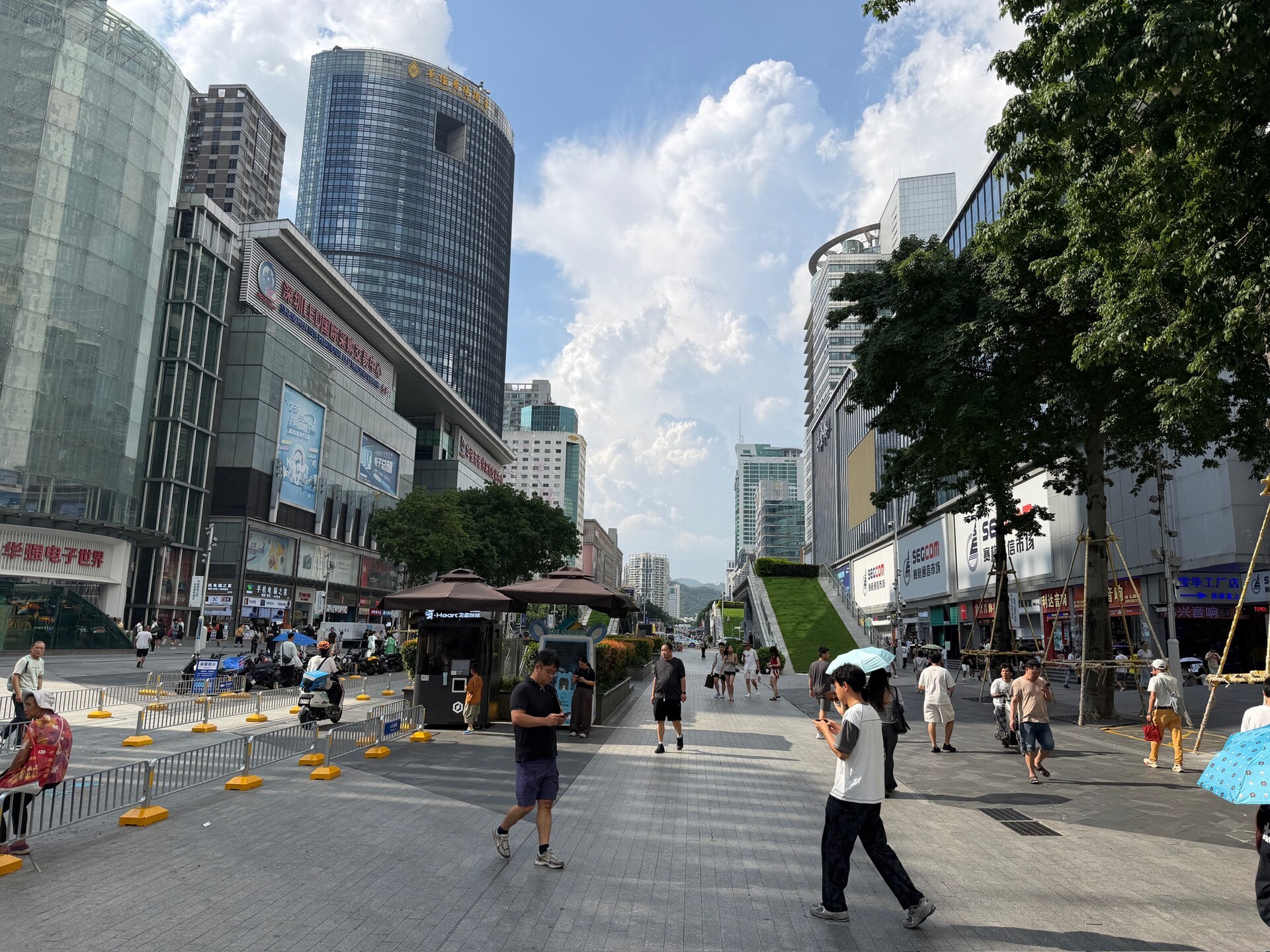
The electronics district in Shenzhen: the physical place behind a city I had already encountered through stories.
And Shenzhen carried another complication for me. This was not actually my first encounter with the city. I first learned about Shenzhen through live performance.
In 2012, This American Life broadcast excerpts from Mike Daisey’s one-man show The Agony and the Ecstasy of Steve Jobs, in which he described disturbing working conditions in Chinese factories producing electronics for Western consumers. This American Life later retracted the episode after significant portions of Daisey’s account were found to have been fabricated or altered. That story mattered to me because it helped construct the Shenzhen I carried with me before I ever arrived there. The message I absorbed was something like this: yes, China had achieved extraordinary manufacturing and technological success—but at what human cost?
There were and are legitimate questions about labor, manufacturing and the human costs buried inside the devices we carry. Daisey’s failure does not erase those questions. What interested me after visiting Shenzhen was something different: how easily one traveler’s dramatic account had become part of what I thought I knew about a place I had never seen. And now I was preparing to become another American traveler returning home with stories about China.
Edward Said spent much of Orientalism examining the ways Western culture constructed knowledge about an “East” that could then be explained, classified and interpreted from the West. I am hardly exempt from that history simply because I know it exists. My experience of China does not make me an authority on China. In fact, my lack of cultural context may be one of the biggest limitations of what I saw. So I am not particularly interested in returning home with a collection of bizarre, novel or “exotic” things and explaining what they reveal about the Chinese.
I am much more interested in something for which I am considerably better qualified: What did seeing China reveal about me? And what did it make visible about America that had become too familiar for me to notice?
Living and teaching in Southampton, England, in 1996 had once given me my first sustained experience of looking at the United States from somewhere outside it. For the first time, I began to understand what it meant to be American because I was no longer surrounded exclusively by Americans. China did something different. It made me begin to notice what it means to be Western. That is what these stories are for.
They are observations, not verdicts. I want to examine the things that surprised, delighted, confused and sometimes troubled me in China, then rack focus back toward the United States and see what comes into view. And I want other people in the frame. If you know China better than I do, I want to know where my interpretation fails. If you are American, I want to know whether looking at these things from another angle changes anything you thought was normal. The discussion is part of the project.
THE LIMIT I WANTED TO KEEP VISIBLE |
My niece gave me one of the simplest lessons in this while we were playing a Chinese children’s geography game called Discover the World. I had been thinking about China as part of “the East” and myself as someone from “the West.” Then I looked at the map. From China, the game made one thing perfectly clear:
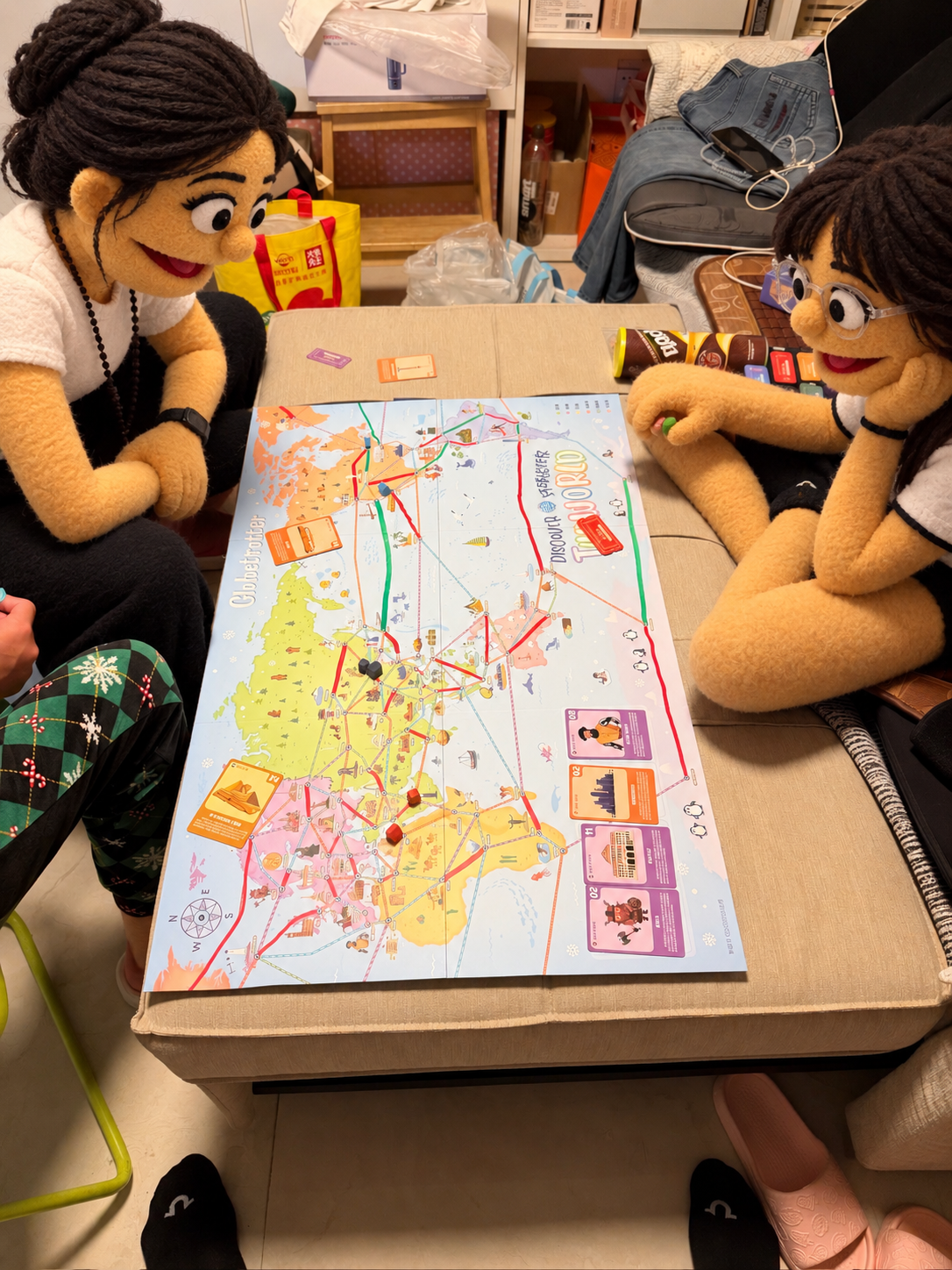
Playing Discover the World with my niece changed the direction of the map—and, briefly, the direction of my thinking.
The United States is East. |
JOIN THE DISCUSSION
What physical spaces once made you want to make, tinker, or experiment—and what changed when those communities moved online?
BIBLIOGRAPHY
Merchant, Brian. “The Secret Black-Market Afterlife of the iPhone.” WIRED, June 28, 2017. https://www.wired.com/story/black-market-iphone/.
Reynolds, Matt. “Inside Shenzhen: The Silicon Valley of Hardware.” WIRED, June 7, 2016. https://www.wired.com/story/shenzhen-silicon-valley-of-hardware-wired-documentary/.
Said, Edward W. Orientalism. New York: Pantheon Books, 1978.
This American Life. “Mr. Daisey and the Apple Factory.” Episode 454. January 6, 2012. https://www.thisamericanlife.org/454/mr-daisey-and-the-apple-factory.
This American Life. “Retracting ‘Mr. Daisey and the Apple Factory.’” March 16, 2012. https://www.thisamericanlife.org/extras/retracting-mr-daisey-and-the-apple-factory.